
YOUR MORTGAGE BROKER
PROPERTY INVESTOR INSIGHTS
Australia's Biggest Property Tax
Shakeup in 30 Years
A complete investor guide to the 2026–27 Federal Budget CGT and negative gearing reforms
With real numbers, three case studies, an interactive tax calculator, and eight strategies to protect your wealth.
In This Edition
On 12 May 2026 at 7:30pm AEST, the Federal Government’s 2026–27 Budget fundamentally altered the landscape for Australian property investors. Two pillars of property investment tax strategy — negative gearing and the 50% capital gains tax discount — are being significantly wound back. Here’s what’s changing, when, and for whom.
Negative gearing occurs when your investment property’s costs — mortgage interest, rates, insurance, maintenance, depreciation — exceed the rent you collect, producing a net rental loss. Under the old rules, this loss could be deducted against any income source, including your salary, cutting your tax bill immediately. There will be changes to pre and post-established properties.
The current 50% CGT discount means investors only pay tax on half their capital gain when they sell a property held for more than 12 months. From 1 July 2027, this discount is replaced with two new mechanisms that work together.
There are number of case studies how the new rules impact your investment.
The charts illustrate how the proposed Capital Gains Tax (CGT) changes would increase the tax burden on property investors over time compared with the current rules. Under the existing system, investors receive a 50% CGT discount on assets held for more than 12 months. The approved changes reduce this benefit, resulting in higher tax payable when an investment property is sold.
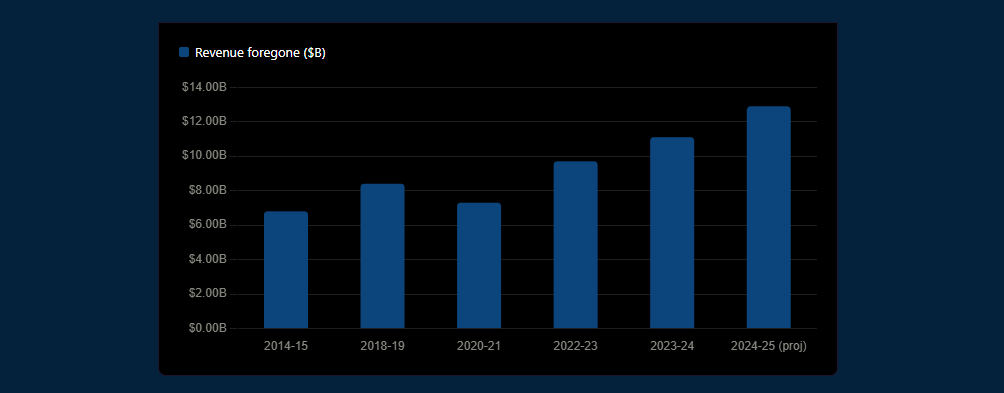
The graphs also provide context on negative gearing, showing the estimated cost to the government in foregone tax revenue each year. While negative gearing allows investors to offset property losses against other income, it represents a significant budget expense.
Together, these charts highlight the trade-off between supporting property investment through tax concessions and increasing government revenue through tax reform. The visual comparison helps demonstrate how changes to CGT and negative gearing could affect investors, housing affordability, and government finances over the long term.
- Pivot to new builds
- Maximise your principal residence
- Invest through your SMSF
- Chase positive cash flow
- Carry forward losses strategically
- Sell grandfathered properties strategically
Newly built properties may become increasingly attractive to investors if changes to negative gearing and Capital Gains Tax (CGT) rules are introduced. Under some proposed reforms, tax concessions could be retained or enhanced for new housing developments while being reduced for existing properties. This approach aims to encourage investment in additional housing supply, helping to address Australia’s housing shortage.
For investors, new builds can offer benefits such as depreciation deductions, lower maintenance costs, modern features that attract tenants, and potential government incentives. As a result, new properties could provide stronger tax advantages and investment opportunities compared with established homes under the proposed policy changes.
Explained under the following topics:
- Interest only vs principal and interest
- Offset accounts to manage cashflow
- Separating investment and personal debt
- Loan structuring for SMSF property.
- Reviewing existing portfolios
Overview
The changes at a glance
On 12 May 2026 at 7:30pm AEST, the Federal Government’s 2026–27 Budget fundamentally altered the landscape for Australian property investors. Two pillars of property investment tax strategy — negative gearing and the 50% capital gains tax discount — are being significantly wound back. Here’s what’s changing, when, and for whom.
1 July 2027
Changes take effect
12 May 2026
Cut-off for existing rules
2.2 M
Property investors in Australia
30%
New minimum CGT rate
12 May 2026, 7:30pm AEST — Budget night cut-off
Properties under contract before this moment are grandfathered. Old rules apply permanently to these investments.
25th June 2026 — Legislation passed
The Treasury Laws Amendment (Tax Reform No. 1) Bill 2026 passed both houses of Parliament on 25 June 2026, following a Senate Economics Legislation Committee inquiry that reported on 19 June 2026. The Bill is now awaiting Royal Assent, the final formal step before it becomes law. During debate, the Government also agreed to remove several discretionary ministerial powers that critics — including the Tax Institute, CPA Australia and the FAAA — had flagged as a transparency concern, including the power to expand negative-gearing-eligible property types or CGT-discount asset classes by ministerial instrument alone. Some technical definitions, including what qualifies as a “new build,” are still to be finalised in supporting legislative instruments, so detail in this area may be refined as those instruments are released.
Properties held before 7:30pm on 12 May 2026 are fully grandfathered — you keep all existing negative gearing and CGT benefits on those investments indefinitely.
Negative gearing
Negative gearing: before and after
Negative gearing occurs when your investment property’s costs — mortgage interest, rates, insurance, maintenance, depreciation — exceed the rent you collect, producing a net rental loss. Under the old rules, this loss could be deducted against any income source, including your salary, cutting your tax bill immediately.
Old rules (pre-12 May 2026)
- Rental loss offsets wages
- Immediate income tax saving
- Applies to all properties
- No restriction on property type
New rules (from 1 Jul 2027)
- Losses only offset rental income
- Or future rental capital gains
- Unused losses carry forward
- New builds fully exempt
Old rules
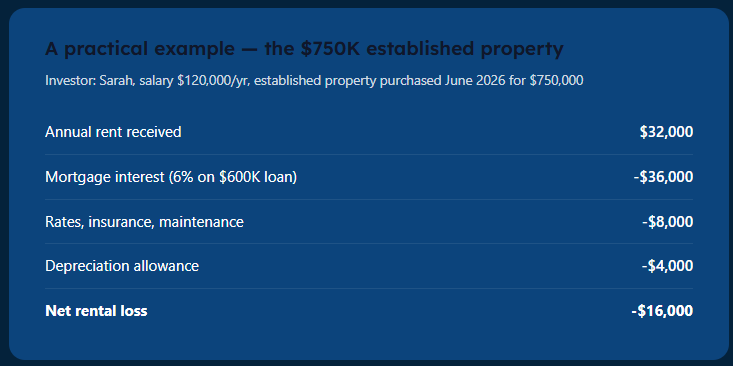
$16,000 loss deducted from $120,000 salary → taxable income $104,000
Tax saving: ~$7,040/yr
New rules
$16,000 loss is quarantined and carried forward, it can still be applied immediately against any other residential rental income Sarah has, and any remaining balance reduces her capital gain dollar-for-dollar when she sells (after indexation is calculated). It is deferred, not forfeited.
Tax saving on salary: $0 in year one — but not $0 overall
Over a 5-year period, this means Sarah’s tax benefit is deferred rather than lost outright. If she has no other rental income to offset against in the meantime, she could forgo approximately $35,200 in cumulative tax benefits compared with the old rules. But this figure assumes the carried-forward loss isn’t used elsewhere and isn’t realised until sale. The actual outcome depends on her broader portfolio and the timing of any future sale.
Capital gains tax
Capital gains tax: the new rules
with real numbers
The current 50% CGT discount means investors only pay tax on half their capital gain when they sell a property held for more than 12 months. From 1 July 2027, this discount is replaced with two new mechanisms that work together.
How the new CGT system works
Cost base indexation:
Properties under contract before this moment are grandfathered. Old rules apply permanently to these investments.
30% minimum tax:
The measures are not yet law. Parliament must pass the legislation; changes possible during the process.
Transitional protection:
Negative gearing restrictions and the new CGT regime both commence. Capital gains accrued before this date are assessed under old rules.
CGT comparison: Old Vs New on a $1M property
Scenario: property purchased Sept 2026 for $800,000, sold in 2032 for $1,100,000 (gain: $300,000). Assumed value on 1 Jul 2027: $820,000. CPI 2.5%/yr over 5 years.
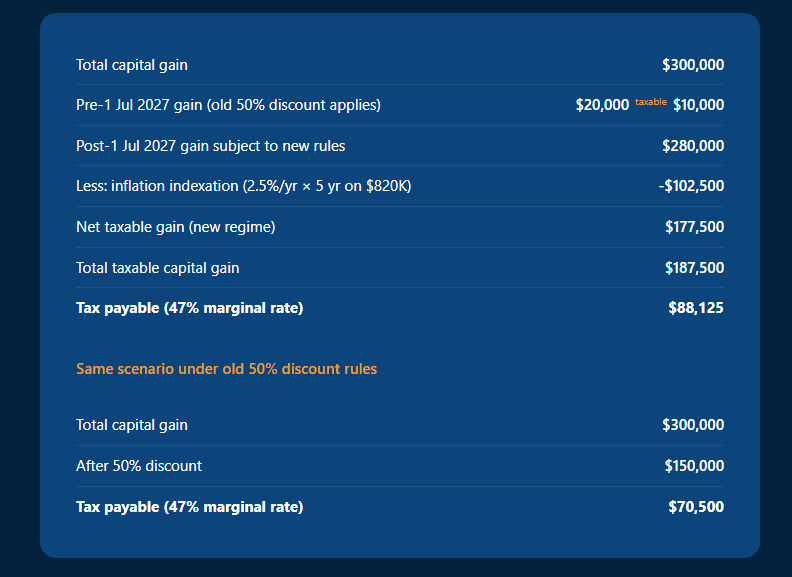
In this example, the new rules cost this investor an additional $17,625 in CGT — a 25% increase in their tax bill on the same gain. The impact grows the longer the holding period, as more of the gain falls under the new regime.
Note: the negative gearing changes apply only to residential property — commercial property and shares are unaffected. However, the removal of the 50% CGT discount (replaced by indexation and the 30% minimum tax) applies more broadly to CGT assets held by individuals, trusts and partnerships, not just residential property. If you hold a mixed portfolio, the CGT change may affect other assets too.
Case studies
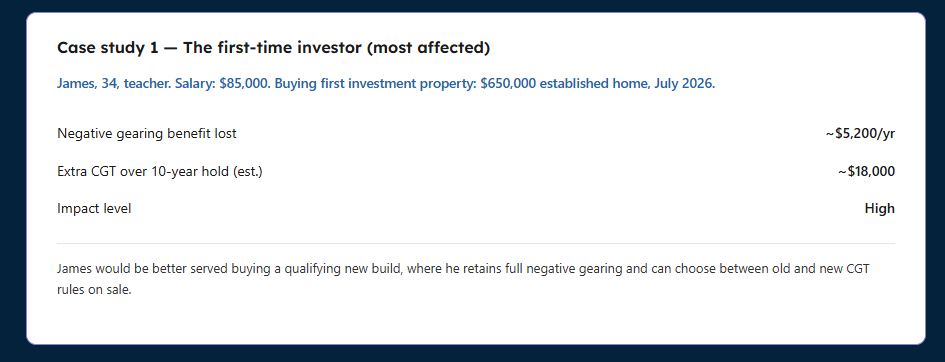
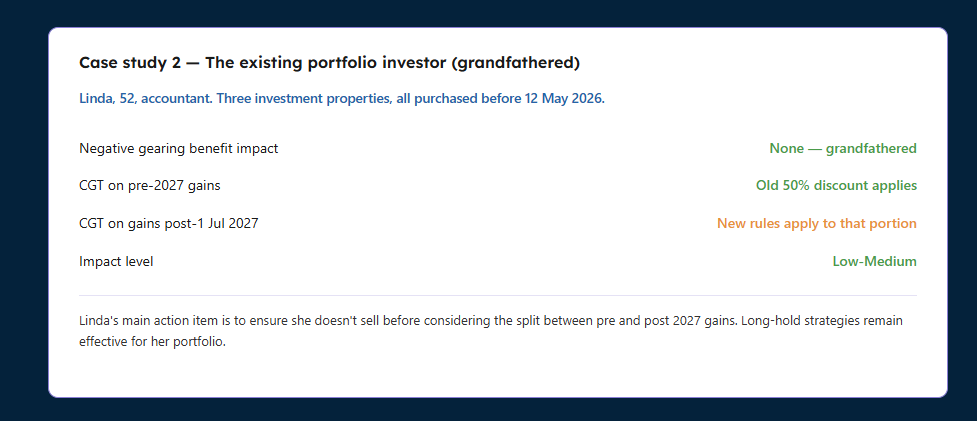
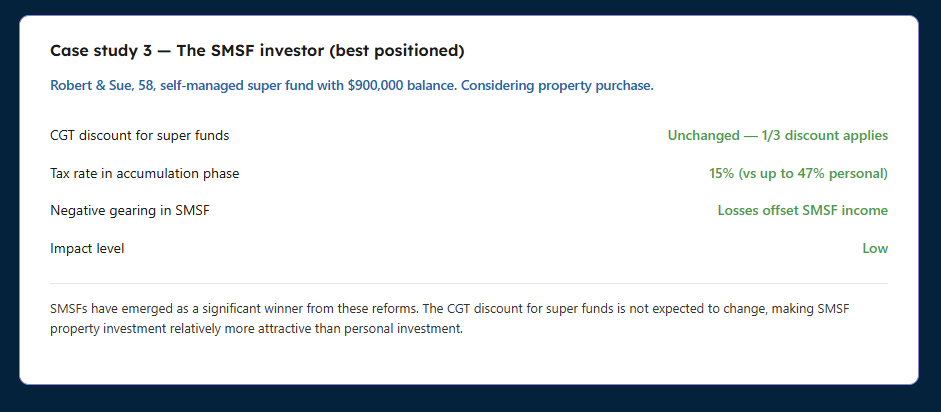
Three investors, three different impacts
Data visualization
CGT burden over time: old rules vs new rules
The chart below shows the estimated CGT payable on a $700,000 property purchased in August 2026, sold in various future years, assuming 7% annual capital growth and a 47% marginal tax rate.
This chart reflects one growth/inflation scenario only. At lower capital growth rates relative to inflation (Treasury’s own modelling shows a break-even around 2.9% CPI per annum), the new indexation rules can produce a lower tax bill than the old 50% discount. Outcomes depend heavily on the relationship between your property’s growth rate and CPI over the holding period.
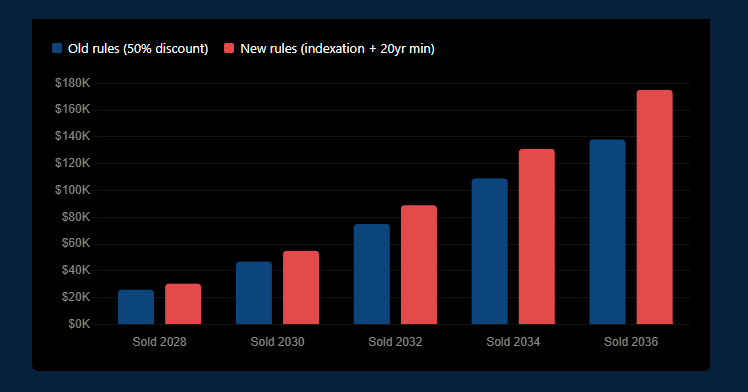
The gap between the two lines widens over time because a greater proportion of the gain falls under the new regime as more years pass after 1 July 2027. Investors who plan to sell well after 2030 face the largest additional tax burden.
Negative gearing
Revenue cost to government
To understand why these reforms happend, consider the scale of the expenditure the government was seeking to address:
Strategies
Smart strategies for property investors in 2026

New builds
The investor's new best friend
The single most important planning opportunity created by the 2026 reforms is the preferential treatment of new residential build. Understanding what qualifies is critical.
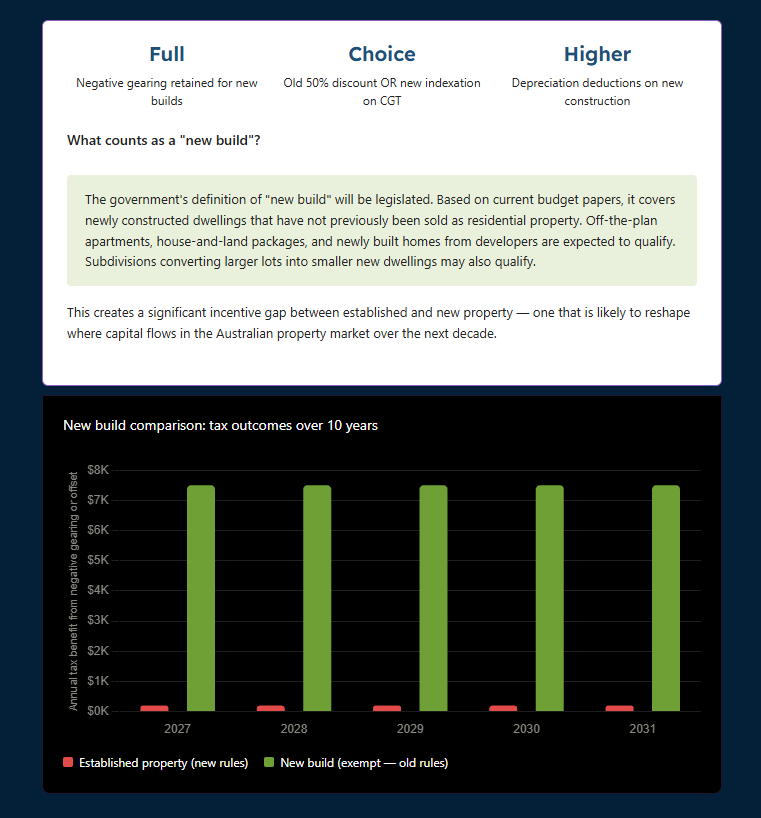
Important: the precise definition of “new build” has not yet been published — it will be set by a ministerial legislative instrument, not the Bill itself. Practical traps to watch for: only the first purchaser of a new build typically qualifies (eligibility can be lost once a property has been sold once, though a builder may hold it up to 12 months without this counting); knock-down-rebuilds generally only qualify if the number of dwellings increases (a like-for-like rebuild may not qualify, but replacing one house with two may); and build-to-rent and affordable/social housing have separate carve-outs. If your strategy depends on new-build status, confirm eligibility before signing a contract.
Mortgage strategy
How the right mortgage structure can help

References
Sources and Further Reading
This newsletter draws on the following official and professional sources. We recommend reviewing the primary government sources directly, as the legislation is still progressing through parliament and details may change.
- Australian Taxation Office— Tax reform: Boosting home ownership, reforming negative gearing and capital gains tax.ato.gov.au
- Australian Government— Budget 2026–27, Tax reform explainer.budget.gov.au
- Australian Government— Budget 2026–27, Tax explainer factsheet: Negative gearing and capital gains tax reform (PDF).budget.gov.au
- Treasury Ministers— Second reading speech, Treasury Laws Amendment (Tax Reform No. 1) Bill 2026.ministers.treasury.gov.au
- Parliament of Australia— Bills Digest: Treasury Laws Amendment (Tax Reform No. 1) Bill 2026 and related Bill.aph.gov.au
- Baker McKenzie— Australia: Budget Bites — CGT discount and negative gearing.bakermckenzie.com
- William Buck Australia— Federal Budget Analysis 2026: Negative gearing.williambuck.com
- Corrs Chambers Westgarth— Capital gains tax and negative gearing amendments: key changes and implications.corrs.com.au
- PwC Australia— CGT and housing tax reform: 2026–27 Federal Budget.pwc.com.au
- SMSF Adviser— Unintended consequences: how the CGT, negative gearing changes impact SMSFs.smsfadviser.com
- The Tax Institute— Submission: Treasury Laws Amendment (Tax Reform No. 1) Bill 2026.taxinstitute.com.au
- Cowell Clarke Commercial Lawyers— Tax reform: draft legislation released.cowellclarke.com.au
- Pitcher Partners— Federal Budget 2026–27: Negative gearing.pitcher.com.au
- BDO Australia— Reforming negative gearing for residential properties.bdo.com.au
- Aussie— What counts as a new build under the 2026 Federal Budget?aussie.com.au
- Commonwealth Bank of Australia— 2026 Budget: Updated housing outlook.commbank.com.au
- Perpetual— Perpetual Wealth analyses the key measures of the Federal Budget 2026.perpetual.com.au
Disclaimer:
This article is general information only. It has been prepared without taking into account your personal objectives, financial situation, or needs, and does not constitute financial, taxation, legal, or credit advice. Nothing in this article should be relied upon as a substitute for advice from a qualified, licensed professional who has considered your individual circumstances.
The negative gearing and capital gains tax changes described in this article were announced as proposed measures in the 2026–27 Federal Budget. As at the date of publication, these measures have not been enacted and remain subject to the passage of legislation through the Australian Parliament. The final form of any legislation — including effective dates, thresholds, definitions (such as what constitutes a “new build”), and transitional or grandfathering arrangements — may differ materially from what is described here. We make no representation or warranty that these measures will be passed in their current form, or at all, and accept no liability for outcomes resulting from reliance on information that is subsequently amended or does not become law.
Accuracy and currency of information
While we have taken reasonable care in preparing this article using publicly available Budget papers and government announcements, tax and superannuation law is complex and subject to frequent change. Figures, dates, tax rates, and thresholds referenced in this article are current as at the date of publication only and may have changed by the time you read this. We do not warrant the accuracy, completeness, or currency of any information contained in this article and recommend you independently verify all figures with the Australian Taxation Office (ato.gov.au) or a registered tax agent before acting.
Worked examples and case studies are illustrative only
All case studies, dollar figures, charts, and calculator outputs in this article (including the examples referred to as Sarah, James, Linda, and Robert & Sue) are hypothetical and illustrative only. They are simplified for educational purposes and do not reflect the circumstances of any real person. They do not account for all variables relevant to an actual tax calculation, including but not limited to: depreciation schedules, capital works deductions, other income, Medicare levy, Division 293 tax, state-based duties and land tax, loan establishment and ongoing costs, or changes in legislation. Actual outcomes for any individual will differ, potentially significantly, from the examples shown. You should not make any investment, lending, or tax decision based on these examples without obtaining advice tailored to your own circumstances.
No tax or legal advice
Credora Finance is a mortgage broking business. We are not registered tax agents, accountants, or lawyers, and nothing in this article should be construed as tax, accounting, or legal advice. Before making any decision in relation to negative gearing, capital gains tax, self-managed superannuation funds (SMSFs), or any other taxation matter, you should consult a registered tax agent, accountant, or lawyer who can advise on your specific circumstances.
Credit and mortgage broking services
Any mortgage broking or lending information referred to in this article, including loan structuring strategies, interest-only lending, offset accounts, and Limited Recourse Borrowing Arrangements (LRBAs) for SMSFs, is general in nature. Credit approval is subject to the lender’s own credit assessment criteria. Terms, conditions, fees, and charges apply. Credora Finance can only recommend a credit product after completing an assessment of your requirements, objectives, and financial situation in accordance with our responsible lending obligations.
Credora Finance Pty Ltd (ABN 46690746199) is a credit representative of AFG.
SMSF property investment risk warning
Investing through a self-managed superannuation fund carries additional risk, complexity, and regulatory obligations under the Superannuation Industry (Supervision) Act 1993 (Cth). SMSF trustees should obtain advice from a licensed financial adviser and a qualified accountant before establishing an SMSF or borrowing within an SMSF, including via a Limited Recourse Borrowing Arrangement. Penalties for non-compliance can be significant. We do not provide financial product advice in relation to superannuation and are not authorised to do so.
Past performance and forward-looking statements
Any reference to historical data, trends, or government revenue figures is provided for context only. Past performance, historical revenue, or historical tax treatment is not a reliable indicator of future performance or future legislative outcomes. Statements about future tax rates, property markets, government policy, or investor behaviour are forward-looking and inherently uncertain.
Email subscription and privacy
By submitting your name, email address, or phone number through this article, you consent to receiving our newsletter and related marketing communications regarding mortgage broking and property finance services. You may unsubscribe at any time using the link provided in our emails or by contacting us directly. We handle personal information in accordance with our Privacy Policy and the Australian Privacy Principles under the Privacy Act 1988 (Cth). We do not sell or share your personal information with third parties for their own marketing purposes. A copy of our Privacy Policy is available at [link to your Privacy Policy].
No liability
To the maximum extent permitted by law, Credora Finance, its directors, employees, and representatives accept no liability for any loss or damage (whether direct, indirect, consequential, or otherwise) arising from any act or omission done in reliance, whether wholly or partially, on any information contained in or omitted from this article.
Copyright and third-party content
References to Budget papers, government announcements, and publicly available statistics are used for commentary and educational purposes. © 2026 Credora Finance . All rights reserved. This article may not be reproduced, in whole or in part, without prior written permission, except for personal, non-commercial use or as permitted under the Copyright Act 1968 (Cth).
Published: June 2026 · Last reviewed: 23rd June 2026· This disclaimer should be read in full and applies to the entire article above, including all charts, calculators, and downloadable materials.